
Classical Indian Philosophy of Education
by:
Professor V. N. Jha
when:
Sunday, September 23, 2012 - 09:00 to 10:15
Any policy of Education is required to be framed in terms of aspirations of people for whom the policy is being framed. In other words, the policy-makers must take into account what people want to achieve in life. Once the goal is identified, the means to achieve that goal can easily be identified.
The classical Indian philosophers added another important dimension to this. According to them it is not enough to take into account what people think as the goal of human life, but also what should be the rational or logically considered ‘goal of human life’. The philosophers suggested that what people consider to be the goal of human life needs to be critically and philosophically examined before recommending that as ‘the goal of life’.
On critical examination, one will find that there is an immediate goal and there should be an ultimate goal of life. The immediate goal cannot be the ultimate goal. In other words, ‘the immediate goal’ should be considered, together with the ultimate or the logical goal and not in isolation.
Classical Indian philosophers’ inquiry about anything, therefore, has always been holistic. The same holistic approach is also found in the case of deciding ‘education’. They felt the necessity of classifying human goals into two categories : (a) immediate and (b) ultimate. Both the goals are equally important. The first goal will take care of all needs of sustenance, comfort and pleasure which all human beings want. This is the minimum that any education must provide. The ordinary aspirations are to be governed by this first order goal. When one aspiration is fulfilled a human being has a feeling of achievement and that gives him or her joy which prompts him or her to go for it again and again in order to achieve more and more. But the Indian philosophers critically analyzed this human psychology and wanted to know whether there is any upper limit of what people consider as ‘achievement’ and their analysis of human experiences forced them to conclude that there cannot be any upper limit of ‘achievement’. They found that human beings suffer from inherent weaknesses and as such the initial minimum ‘want’ or ‘need’ gets transformed into ‘greed’ and greed has no upper limit. That is why, this, so-called ‘achievement’, cannot be posited as the ultimate goal of human life. This goal cannot be recommended as the ultimate purpose of human life because this will never allow a human being to have a sense of fulfillment. That is why, the classical Indian thinkers introduced the idea of four-fold goal of human life, the fourth being the ultimate goal of life called ‘fulfillment’ which alone can generate a sense of ‘peace’ or a sense of ever-lasting happiness by putting a check on the tendency of ‘greed’.
In classical Indian philosophers’ view ‘education’ is a means of transforming human beings from a lower state to a higher state. Education must liberate small minds and transform them to universal minds. On one hand, as it should take care of the basic needs of one and all, on the other, it should also show the path to move towards their ultimate goal of life. The ‘education’ which does not take into account the ultimate goal of life namely, a sense of fulfillment, is no education at all. In other words, ‘education’ must aim at transforming a man in such a way that he or she ultimately gets a feeling of ‘fulfillment’ or from ‘exclusiveness’ to ‘inclusiveness’. Transformation is understood as gradual ‘freedom from narrowness or bondage’ and complete transformation will mean complete freedom from all narrowness, conditioned state of mind, and identification of the universals. The classical Indian philosophers have identified that ultimate state as the state of discovering one’s own self. A true education must lead one to that state ultimately. No ‘education’ which does not do this job is worth its name.
This paper aims at presenting this universal philosophy of education as developed by the classical Indian philosophers, right from the Vedic period. This philosophy does not preach running away from the mundane responsibility or discourages one from going for more and more achievements , rather it teaches how to incorporate spirituality in general education so that one can live a harmonious life without causing any harm to any body, including the environment and nature. Once the essential identity between matter and spirit is realised, one is convinced that doing harm to nature amounts to doing harm to oneself and so there is no scope of tension of any kind.
If such a model of education is adopted, there should be no scope for any turmoil of any kind that the world is facing today.
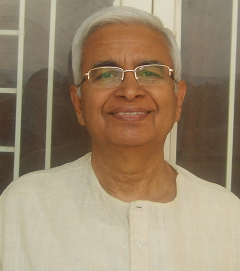
Born in 1946 at Raiganj (northern part of West Bengal); Educated at Raiganj (Graduation from North Bengal University); Banaras Hindu University(M.A. in Sanskrit with Vedic group); Calcutta University(M.A. in Comparative Philology); Pune University(Ph.D); Received special training in traditional Sanskrit learning at Raiganj and Pune from Pandita Sitakanta Acharya, Srinivasa Sastri and Sivaramakrishna Sastri in Grammar, Indian Logic and Indian Hermeneutics;
Taught in Pune University and retired in the year 2006 as Director of the Centre of Advanced Study in Sanskrit;
First Chairperson, Special Centre for Sanskrit Studies, Jawaharlal Nehru University, New Delhi;
Authored and edited about 50 books and published over 150 research articles;
35 scholars received Ph.D. degree under my supervision;
Promoted interdisciplinary and multidisciplinary study and research in Indian intellectual , philosophical and spiritual culture;
Honoured by a number of academic institutions;
Were visiting professor in Humboldt University, Germany; Nagoya University, Japan; University of Lausanne, Switzerland; and Mahatma Gandhi Institute, Mauritius;
Life-member of a number of academic bodies and societies;
Participated and organized a number of national and international seminars and conferences;
Presently engaged in training and disseminating classical Indian knowledge systems, all over India, in contemporary idiom.